
Save Some Hope for the Adults
If having kids is a hope-filled endeavor, then it's a total vote of confidence that adults will change the world.


I read an essay this weekend by Kyle Harrison, an investor at Contrary Capital. Kyle makes an argument for having kids, calling it a fundamentally hope-filled endeavor.
I think most adults see kids, or have kids of their own, and see potential. They see someone unburdened by life, without the bumps and bruises of past mistakes, and think “you have the ability to do extraordinary things with your life.” It’s why parents feel such immense disappointment when their kids drop out of school, make poor financial decisions, or generally do things that will clearly make their long-run outcomes worse.
Kids have some advantages over adults. They haven’t made adult-level mistakes, sure. But they also learn new things at lightning-speed, their brains unburdened by calcified neuroplasticity, not yet exchanging easy net-new neural pathways for the efficient and specialized ones we develop in adulthood. But I don’t think we give enough credit to the adult brain, because it has its own advantages.
I wrote last week that living a good life probably means: (1) discovering new things about yourself over time. Discover what you like and what captures your interest - the things you want to focus on. Discover what you’re good at, and how you hope to spend your time. (2) Then take action. Make changes and focus on those things. There’s something hardwired into your DNA that dictates the sort of person you’re best-equipped to become, the problems you’re best-equipped to handle, and the impact on the world you’re uniquely positioned to lead. (3) Finally, focus on those things for as long as humanly possible.
If the benefit of childhood is unbridled potential and an unscathed psyche, the benefit of adulthood is the knowledge of who you are and how you can live life well. So, if most of us feel hope and optimism when we meet a kid, then shouldn’t we feel the same when we meet an adult?
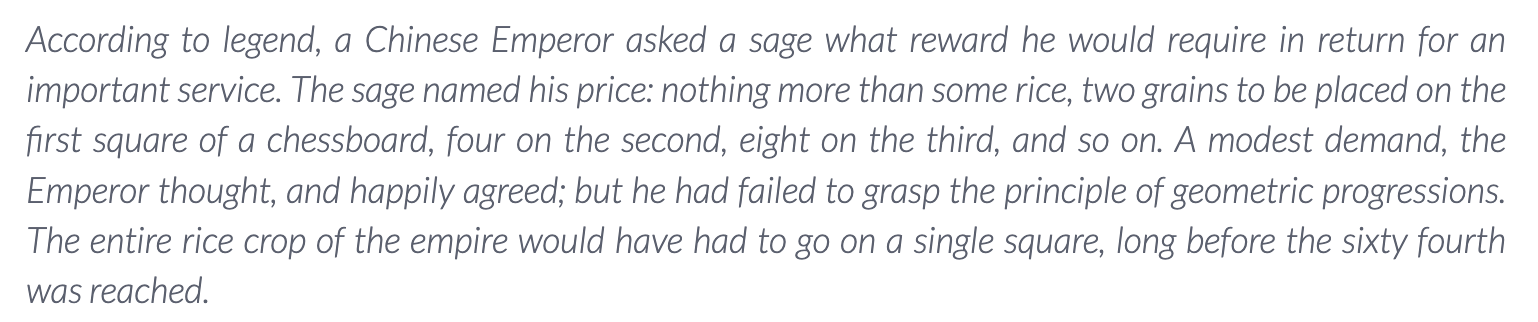
The most powerful things in life compound - they grow exponentially over time. The classic example of this is a retirement account, which doubles in value every seven years, similar to the old adage about the emperor’s chessboard, giving rice to a member of his kingdom.
We grow more powerful as our skills and self-knowledge compound. They compound quite literally as we discover new things and incorporate those things into how we lead our lives. It’s an iterative feedback loop of trial and error, where we learn something new, apply it to our daily lives, and then grow more powerful as a consequence.
This is the only way an adult can really make the most of their time on earth, and is therefore what we should also hope for kids: become the sort of adult whose skills and interests compound over time, because then you have a shot at changing the world.
Glad to see another piece so soon.
I do have hope and optimism when I meet adults along with kids which likely why we are friends.
Best wishes Dan.